
Collecting Canines
Royal Doulton Dog Figurines: The Sculptors, the Backstamps, and Six Pieces Worth Knowing
Royal Doulton Dog Figurines:
The Sculptors, the Backstamps, and Six Pieces Worth Knowing.
A field guide to Frederick Daws, Cecil Aldin, the marks on the bottom, and the dogs currently on our shelf — by Donna at A Dog’s Tale Collectibles
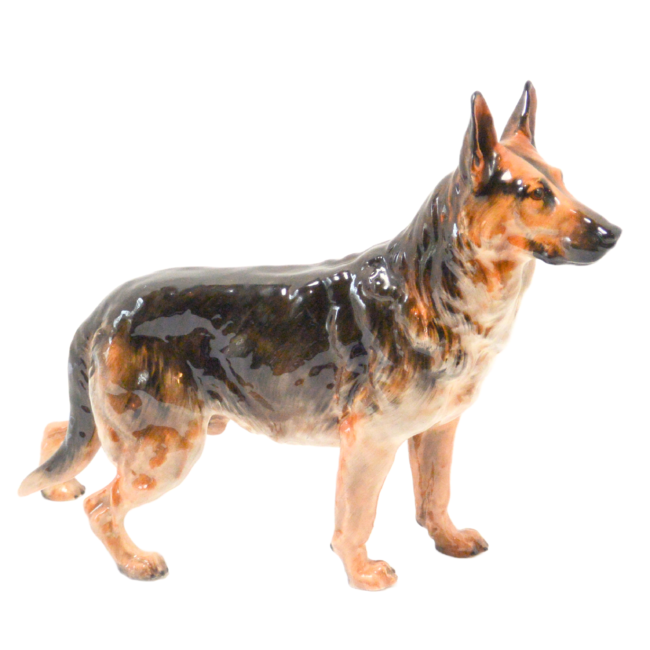 |
Royal Doulton German Shepherd HN 1115, “Giant” scale by Frederick Daws — in stock |
Flip a Royal Doulton dog over and the bottom tells you everything. A small two-letter prefix, a number, the lion-and-crown stamp — sometimes a sculptor’s initials and a year code. Read it once, and you can date the piece to within a few years, name the sculptor, and place it inside the firm’s seventy-year run of canine modeling.
This is a guide for collectors who want to understand what makes a Royal Doulton dog worth the shelf space. Our team has handled many of these pieces over the years, and the patterns become clear once you start looking. We’ll walk through the HN system, the K-series, the Frederick Daws style, Cecil Aldin’s “Dogs of Character,” and pieces on our shelf — with the “Giant” German Shepherd above as the rare anchor.
What’s Inside This Guide
1. A Brief History of Royal Doulton’s Dogs
2. What HN Actually Stands For
3. The K-Series: Smaller Pieces, Smaller Stories
4. Reading the Bottom of a Royal Doulton Dog
5. Frederick Daws and the Dog Form
6. Cecil Aldin and the “Dogs of Character”
8. The Centerpiece: HN1115 Giant German Shepherd
9. Building & Caring for a Royal Doulton Collection
A Brief History of Royal Doulton’s Dogs
Royal Doulton began as Doulton & Watts in 1815 in Lambeth, London, making stoneware industrial vessels. The Burslem pottery in Staffordshire joined the firm in 1877 and became the home of the figurine work the firm is best known for today. The royal warrant arrived in 1901 from Edward VII, and Doulton became Royal Doulton.
The dog figurines came into their own in the 1920s and 1930s. Royal Doulton was not the only English maker producing porcelain dogs at the time — Beswick, Worcester, and a handful of smaller firms were all in the field — but Royal Doulton’s combination of sculptural realism, glaze quality, and an organized numbering system set its dog line apart. The pieces sold in dog-show gift shops, department stores, and gift stores across Britain and the United States. Today they remain among the most collected canine collectibles, in part because the system makes them so identifiable.
What HN Actually Stands For
The HN system began in 1913. Most collectors today say HN stands for “Harry Nixon,” head of the painting department at Burslem when the system was introduced. Royal Doulton itself has never officially confirmed this, and a small number of collectors prefer alternative explanations, but Nixon’s name has stuck. Whatever the letters originally stood for, the convention has been consistent for over a century — numbers were assigned in order from HN1 forward as new figures were introduced.
Each HN number marks a specific model in a specific colorway. This is the part that surprises new collectors. If Royal Doulton sculpted a Cocker Spaniel and painted it three different ways — black-and-tan, golden, and parti-color — each color version received its own HN number. The Cocker Spaniel alone carries more than a dozen HN numbers across its production history. So when you see HN1097 and HN1078 on two superficially similar Cockers, you are looking at two different official products, each with its own catalog entry.
The HN system ran from 1913 until 1985. Any HN-numbered Royal Doulton dog you find today was produced inside that seventy-two-year window. Pieces from the 1920s through the 1950s are generally the most prized — the earlier numbers, HN1 through roughly HN1500, capture the formative years when the firm was establishing its style. By the 1960s and 1970s, production had become more mechanized, and many collectors find those later pieces less expressive than the hand-painted work of the interwar decades.
The K-Series: Smaller Pieces, Smaller Stories
Alongside the HN system, Royal Doulton introduced a parallel K-series in 1931. The K-series was reserved for small-scale figurines, often puppies or compact poses. Where HN models tended to be display-shelf pieces in the three-to-eleven-inch range, K pieces were closer to four inches and were designed to be collected in pairs or sets.
The K-series includes some of the most charming Royal Doulton dogs ever made. K7 and K8 are a Fox Terrier pair sculpted as companion pieces — most collectors who have one eventually find the other. K9 is a small Cocker Spaniel puppy that pairs naturally with the larger HN1188 adult Cocker; both will sometimes appear in collections as a “father and son” set, even though Royal Doulton never marketed them that way. K-series pieces typically sell below HN pieces of the same breed, which makes them a sensible entry point for a collector building a Royal Doulton shelf on a modest budget.
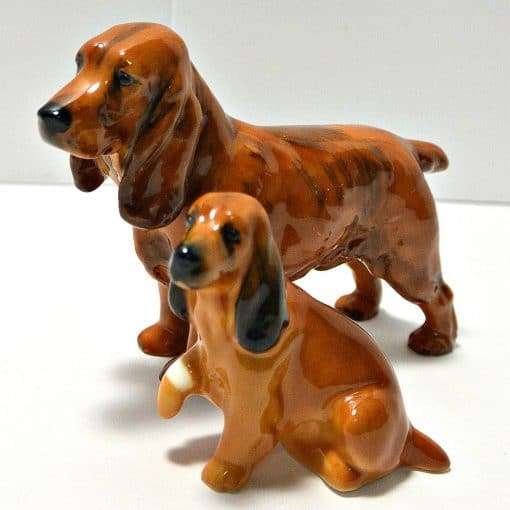 |
Royal Doulton Cocker Spaniel Pair HN1188 & K9 — the classic HN-and-K “father and son” pairing — in stock |
Reading the Bottom of a Royal Doulton Dog
Turn any Royal Doulton dog over and you should see three things, usually arranged from the outer ring of the base inward — the lion-and-crown Royal Doulton stamp, the model name with its HN or K number, and the sculptor’s painted initials or a small date code. Not every piece will have all three. Earlier pieces sometimes carry only the stamp and number, and some painted initials wore off through cleaning over the decades. When all three marks are present, you have near-complete provenance.
The lion-and-crown Doulton backstamp is typically printed in green or gold ink; black and red are rarer. The shape and size of the lion vary slightly across decades, and an experienced collector can sometimes date a piece by the stamp alone. The model name and number are usually hand-painted in a simple script, often in black. The sculptor’s initials, when present, are small — two or three letters in a discreet corner of the base.
Date codes were not used consistently across the entire HN run, but when they appear they take the form of a small two-digit number that corresponds to a year. A piece marked “32” was produced in 1932. Some pieces also carry a registration number or a “Made in England” mark — both useful supplementary clues when the HN number alone leaves you uncertain about the era.
A useful tip — early hand-painted marks have a slight irregularity that mass-production cannot replicate. If a printed mark looks too uniform for the supposed era, that is worth a second look.
The Bone China Test
Beyond the marks, the body of the piece itself tells you whether you are holding genuine Royal Doulton. Authentic Royal Doulton dogs are fired in fine bone china — a very white, slightly translucent material that rings cleanly when tapped with a fingernail. Hold a piece up to a strong lamp; the thinner sections, particularly around the ears and tail, will admit a faint warm glow. Tap lightly near the base and you will hear a clear musical note rather than a flat thud.
Reproductions and outright fakes are usually fired in earthenware or a lower-grade porcelain that is opaque, slightly grey, and gives a duller sound when tapped. Paint quality is the other tell. Royal Doulton’s painters were trained professionals working with carefully controlled pigments — details are crisp, color transitions are deliberate, and the gloss has depth. Crude brushwork, muddy color edges, or a chalky matte finish are red flags. None of these tests are conclusive on their own, but together with a period-correct backstamp they make a confident identification.
Frederick Daws and the Dog Form
Of the sculptors who worked on Royal Doulton’s dog line, Frederick Daws is the name most closely tied to the breed studies that defined the firm’s mid-century style. Daws joined the Burslem studio in 1924 and continued working there into the 1950s. His training was in modeling from life, and it shows clearly — the dogs Daws sculpted have the calm, observational quality of animals captured mid-pause rather than animals posed.
Daws’s style is restrained. The dog stops to listen for a moment, head tilted slightly, weight shifted to the front paws. That moment is what Daws sculpted. Compare a Daws Bulldog to a Bulldog from another firm of the era and the difference is immediate — where others emphasized the jowl and chest, Daws kept the proportions natural and let the breed’s actual silhouette do the work.
Daws worked across many breeds. The Fox Terrier in standing and seated poses across several HN numbers; the Bulldog (HN1042, HN1047, HN1074 and others), often in the brindle finish that became something of a Daws signature; the parti-color Cocker Spaniel HN1078; and various terriers, dachshunds, and retrievers all appear in his catalog. Many of these models stayed in production for years with the same HN number. Below are two of his best on our shelf right now — the seated Fox Terrier HN910 and the large Rough Collie HN1057, modeled on the champion “Ashtead Applause.”
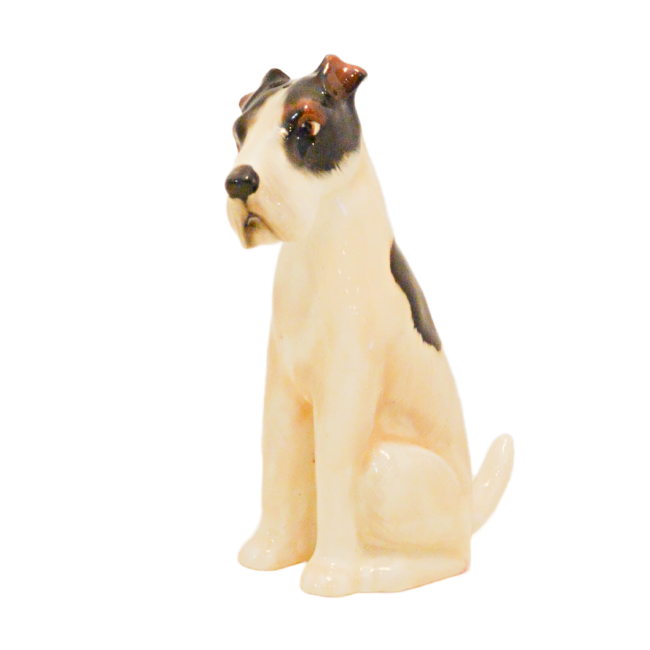 Seated Fox Terrier HN910 — in stock |
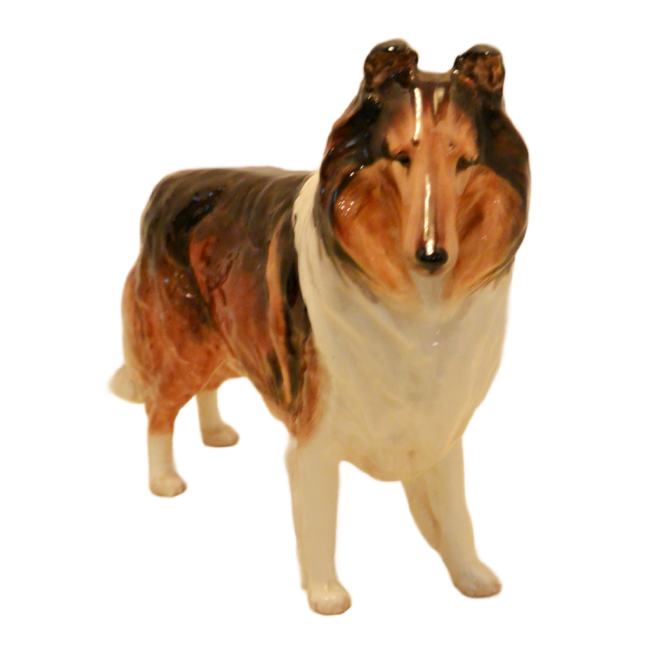 Rough Collie HN1057 “Ashtead Applause” — in stock |
Other Royal Doulton sculptors contributed meaningfully to the dog line as well. Charles Noke, the firm’s art director through the 1930s, modeled some of the early dog pieces. Peggy Davies, who came to prominence after the Second World War, worked on later figurines. For collectors focused on the classic 1920s-through-1950s output, Frederick Daws is the name that recurs most often, and a Daws-attributed piece typically carries a modest premium over a comparable piece by an unattributed sculptor of the same era.
Cecil Aldin and the “Dogs of Character”
If Frederick Daws sculpted the dog as it actually stood, Cecil Aldin drew the dog as it felt to live with. Aldin (1870–1935) was the British illustrator whose pen-and-ink dog portraits shaped popular ideas about canine character for an entire generation of English readers. His scruffy terriers, sleepy bulldogs, and big-eared puppies turned up in children’s books, dog calendars, and Sporting and Dramatic News — and they were drawn from life, often from the dogs Aldin kept at his Berkshire home.
Royal Doulton translated that sensibility into ceramic with the “Dogs of Character” series — a run of figures based directly on Aldin’s illustrations. Where the Daws pieces aim for breed accuracy, the Aldin-derived figures aim for personality. A small dog scratching an ear with a back paw. A puppy curled on a cushion with one eye half open. A terrier-type with a comic, slightly disreputable expression. These are not dog-show portraits. They are companions caught in domestic moments, and they are deeply, deliberately warm.
For collectors, the Aldin pieces sit in their own corner of the Royal Doulton catalog. They tend to be smaller than the formal HN breed studies, they show a lighter painterly hand, and they are often the pieces a collector becomes most attached to over time. If you have ever owned a dog with more personality than pedigree, the Aldin figures will speak to you. Our team keeps an eye out for them, and when one of the Dogs of Character comes through to us, it usually does not sit long.
|
Six Pieces from Our Shelf Worth Knowing
Our team currently has a number of Royal Doulton dogs in stock, and the six pieces in this section are a good cross-section of what the firm produced at its best.
The Seated Fox Terrier HN910
Frederick Daws at his most observational. The Fox Terrier sits with the slight head tilt the breed is known for, weight balanced cleanly on the haunches. This pose is one of the defining Daws compositions — bone china, lion-and-crown backstamp, hand-painted charcoal and tan markings on a crisp white ground.
The Black & Tan Dachshund HN1128
Daws modeled the HN1128 from the champion “Ch. Shrewd Saint,” and Royal Doulton produced it for nearly five decades from 1937 to 1985. The color split is precise without being mechanical — the painter let the natural curves of the dog guide where the colors meet. The expression is unmistakably Dachshund: clever, alert, perhaps just slightly stubborn.
The English Bulldog HN1047
Another Daws piece, in brindle finish with broad chest and head held low. The brindle glaze on Doulton Bulldogs of this era is particularly hard to replicate, and good examples are increasingly sought after by Bulldog-specific collectors. Ours has the “swashbuckling” stance, the droopy jowls, and the wrinkles all properly defined.
The Porcelain Scottish Terrier HN1016
A classic example of the breed in good vintage condition — compact, alert, and full of character. The Scottie was one of the firm’s most consistently produced breeds, modeled by Daws on the champion “Albourne Arthur” and issued from 1931 to 1985. Marked with the Royal Doulton stamp on the bottom of his left front paw and HN1016 on the right back paw.
The Rough Collie HN1057 — Champion “Ashtead Applause”
The most premium piece on our shelf right now. Ashtead Applause was a real show Collie of the period, and Daws captured the dog’s calm, lifelike posture in a large-scale figure that anchors a collection rather than builds it — ten inches long, the iconic “Lassie” silhouette in rich, hand-painted gloss.
The Cocker Spaniel Pair HN1188 & K9
The HN-and-K pairing in one purchase. The HN1188 father in golden brown with darker highlights, and the K9 puppy seated beside him — modeled with a bandaged paw, in matching glaze. Both pieces are stamped on the bottom; both Daws designs from the mid-1930s. A natural starting point for a collector who wants to see how the two numbering systems sit next to each other on a shelf.
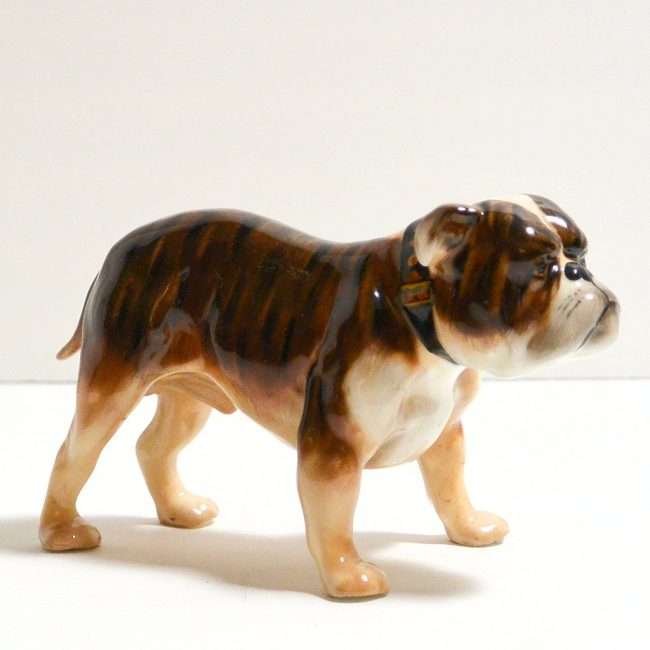 English Bulldog HN1047 (Brindle) — in stock |
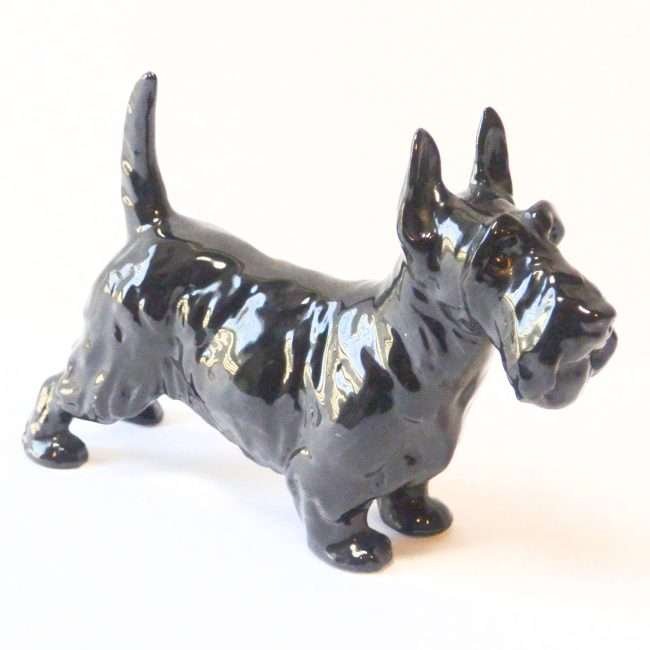 Scottish Terrier HN1016 — in stock |
The Centerpiece: HN1115 Giant German Shepherd
The piece pictured at the top of this guide is the one we are most excited to have in stock right now — the Royal Doulton German Shepherd HN1115, what collectors call the “Giant” Shepherd. At a full eleven inches, this is among the largest Royal Doulton dogs you will ever find. HN1115 is a Frederick Daws design, modeled on the champion “Benign of Picardy,” issued in 1937 and retired in 1960. The scale alone sets the piece apart. Most Royal Doulton dogs sit on a mantel among other pieces. HN1115 is designed to be the centerpiece of the room.
The Giant German Shepherd was produced in the late 1930s and 1940s, with surviving examples concentrated in private collections rather than on the open market. When one comes up for sale, it tends to move quickly. Ours is in collector-grade condition with the original hand-painted glaze intact — a multi-tonal tan and black saddle pattern in high-gloss finish — and a crisp HN marking on the base.
Building & Caring for a Royal Doulton Collection
If you are starting a Royal Doulton dog collection, our team’s advice is to begin with the breeds you actually love and let the rest follow. Collectors who try to acquire every HN number quickly find themselves spending heavily on pieces they do not connect with. The collectors who stay in the hobby for decades tend to be the ones who built around two or three breeds — usually breeds they have owned, shown, or have a family connection to. The personal connection is what holds a collection together.
Buy the best condition you can afford. A perfect example of a common piece is almost always a better long-term hold than a damaged example of a rare piece. Look for clean marks, no chips on the base or ears, no hairline cracks under raking light, and no signs of restoration. Restoration is not always disqualifying — well-executed professional work on a rare piece can still be worthwhile — but it should be disclosed by the seller and reflected in the price.
Pay attention to the sculptor when you can identify them. Daws-attributed pieces tend to hold value better than pieces from less-celebrated sculptors. And keep records — a notebook or spreadsheet of what you own, where it came from, what you paid, and any condition notes. That becomes invaluable for insurance, for estate planning, and for the eventual passing of the collection to the next generation.
For deeper research, two reference points are worth knowing. The Charlton Standard Catalogue of Royal Doulton Figurines is the comprehensive printed catalog used by serious collectors and remains the standard reference for HN numbers, production dates, and rarity. The Royal Doulton Collectors’ Club maintains parallel records and will help with identification questions. The Wikipedia entry for Royal Doulton is a useful starting point for the company’s wider history.
Caring for the Pieces You Have
Display Royal Doulton dogs away from direct sunlight, which can fade painted detail and affect the glaze. Dust gently with a soft brush. If a piece needs more thorough cleaning, lukewarm water with a small amount of mild dish soap on a soft cloth is the safe approach. Dry thoroughly before returning to display. When packing for moves, wrap each piece individually in acid-free tissue, then in bubble wrap. The ears, tails, and base edges are the most vulnerable points on most dog figures, and that is where chips tend to occur.
Frequently Asked Questions
What does HN stand for on Royal Doulton dog figurines?
Most collectors take HN to stand for “Harry Nixon,” the head of figure painting at the Burslem studio when the numbering system began in 1913. Royal Doulton has never officially confirmed the attribution, but the convention has held for over a century. Every HN-numbered piece is a specific model in a specific colorway, and the same dog in a different paint scheme will carry a different HN number.
Who was Frederick Daws, and why does his name matter?
Frederick Daws was the Royal Doulton sculptor most closely associated with the firm’s breed-accurate dog studies from the mid-1920s through the 1950s. He worked from life, often from champion show dogs, and many of the most collected HN dog figures — the Bulldog HN1047, the Scottish Terrier HN1016, the Rough Collie HN1057, the Giant German Shepherd HN1115 — are Daws designs. A Daws-attributed piece typically carries a modest premium over a comparable piece by an unattributed sculptor of the same era.
How do I tell if a Royal Doulton dog figurine is authentic?
Check three things together: the backstamp, the body, and the paint. The lion-and-crown Doulton stamp on the base should be period-correct for the HN number; the body should be bone china, which is white, slightly translucent under strong light, and rings cleanly when tapped; the painting should be crisp, with deliberate color transitions and a glossy depth. Earthenware bodies, opaque grey porcelain, and muddy brushwork are all warning signs. Cross-reference the HN number with the Charlton Standard Catalogue if you want a definitive answer.
Are K-series Royal Doulton dogs less valuable than HN pieces?
Usually yes, on a per-piece basis — K-series figures are smaller and were produced in larger numbers, so they typically sell below comparable HN pieces of the same breed. That makes them an excellent entry point. They are not less collectible, just less expensive, and certain K pieces — particularly the ones that pair with adult HN dogs, like K9 with HN1188 — have meaningful collector demand in their own right.
Where can I find authentic Royal Doulton dog figurines for sale?
Browse our Royal Doulton dog figurines collection — every piece is individually listed with sculptor attribution, HN number, production dates, and condition notes. Our team verifies the backstamp and bone china quality on every piece before it comes onto the shelf.
A Final Note
The Royal Doulton dog line is one of the most documented and collectible chapters in twentieth-century English porcelain. The combination of an organized numbering system, named sculptors, and consistent quality of production means every piece you collect has a story you can trace. Once you start reading the bottom of every Royal Doulton dog you see — whether on our shelf, in a shop, or in a friend’s cabinet — the whole field opens up.
Our team is always happy to help with attribution questions. If you have a Royal Doulton dog and are not sure what you have, send us a photo of the bottom along with a photo of the piece itself. We will tell you what we can about the sculptor, the era, and where the piece sits inside the broader Royal Doulton catalog. The marks are there to be read. And when one of our pieces is the right one for your shelf, it will be perfectly protected and beautifully wrapped just for you.
|
About the Author Donna O’Connor is co-owner of A Dog’s Tale Collectibles, where our team hand-selects antique and vintage dog collectibles for collectors and dog lovers across the United States. We specialise in European bronzes, prestige porcelain, fine jewelry, and one-of-a-kind pieces that celebrate the dogs we love. |