
Collecting Canines
Dachshund Collectibles: Bronze, Porcelain & Silver Treasures for Every Collector
Dachshund Collectibles:
Bronze, Porcelain & Silver Treasures for Every Collector.
By Donna at A Dog’s Tale Collectibles
 |
Austrian Cold-Painted Bronze Dachshund Bride & Groom — Currently in Our Shop |
Few dog breeds have inspired the sheer volume of antiques and collectibles that the Dachshund has. From hand-cast Viennese bronzes to prestige porcelain from Royal Doulton, Royal Copenhagen, and Royal Bayreuth, the beloved “sausage dog” has been celebrated in art, craft, and fine decorative objects for well over a century.
It’s not hard to see why. The Dachshund has one of the most unmistakable silhouettes in the canine world — that long, low body and those short, determined legs make for a perfect sculptural subject. Artists have been capturing that shape, and that irresistible personality, ever since the breed became a darling of European aristocracy in the 1800s.
| Whether you’re a long-time Dachshund devotee building a serious collection, a dog lover just discovering the world of antique collectibles, or searching for the perfect gift for the Dachshund enthusiast in your life — this guide is for you. We’ll walk you through the most sought-after categories of dachshund collectibles, what makes each one special, and how to spot the real thing. | 🔈 Listen |
What’s Inside This Guide
1. Germany’s Most Collectible Dog — A Brief History
2. Austrian Vienna Bronzes — The Pinnacle of Miniature Craft
3. Royal Bayreuth — Germany’s Master of Figural Porcelain
4. Royal Doulton — Britain’s Champion Dachshund
5. Royal Copenhagen — Scandinavia’s Beloved Dachshund Puppy
6. Vintage German Porcelain — One-of-a-Kind Dachshund Art
7. Dachshund Jewelry — Collectibles You Can Wear
Germany’s Most Collectible Dog — A Brief History
The Dachshund is a German dog to its core. The name translates directly as “badger dog” (Dachs = badger, Hund = dog), and the breed was developed over centuries specifically to hunt badgers underground. That long body, those short legs, and that fearless spirit weren’t accidents of breeding — they were precision engineering for a very specific job. The Dachshund could follow a badger into its burrow and hold it at bay until the hunter arrived.
From Hunting Dog to Royal Companion
By the 19th century, the Dachshund had made the leap from working field dog to cherished companion — and royal companion at that. Queen Victoria of Britain was famously devoted to the breed, keeping multiple Dachshunds at court and doing much to elevate their status across Europe. Where royalty led, fashionable society followed, and soon that distinctive silhouette was appearing in paintings, sculptures, and decorative objects across the continent.
Artists and craftspeople couldn’t resist the form. The long, low body was perfectly suited to sculptural treatment in bronze, porcelain, and silver — and the Dachshund’s personality (stubborn, loyal, endlessly expressive) gave artists something to work with that purely elegant breeds couldn’t offer. A Dachshund can be regal, comical, tender, and mischievous, sometimes all at once, and the best antique pieces capture that beautifully.
A Breed Beloved by Artists and Collectors
The depth of Dachshund cultural history is remarkable. The breed was chosen as the first Olympic mascot at the 1972 Munich Games — a bobblehead Dachshund named Waldi that became one of the most beloved mascots in Olympic history. Pablo Picasso was devoted to his Dachshund Lump, who appears in several of his works. The “Wackeldackel” — a nodding Dachshund dashboard ornament — became a German cultural institution in the 1970s. There is even a dedicated Dachshund Museum (Dackelmuseum) in Passau, Germany, with over 10,000 objects celebrating the breed.
The result is a collecting category unlike almost any other: the variety of antique and vintage dachshund collectibles is vast, spanning every material, price point, and level of craftsmanship. This guide focuses on the finest of them.
|
Austrian Vienna Bronzes — The Pinnacle of Miniature Craft
For many serious collectors, Austrian cold-painted Vienna bronzes represent the absolute pinnacle of antique dachshund collectibles. These extraordinary miniatures were produced in Vienna from roughly the 1860s through the early 20th century, combining superb bronze casting with meticulous hand-painted decoration applied in multiple layers — “cold painted” because the paint was never fired in a kiln, but built up with extraordinary patience and skill by hand.
The Genius of Franz Bergman
No name looms larger in the Vienna bronze world than Franz Xaver Bergman (1861–1936). His father opened the Bergman bronze foundry in 1860, and Franz Xaver inherited and expanded it into one of the most celebrated workshops in Vienna. The studio is known today for three categories of work: Orientalist sculptures, whimsical animal figures, and erotic Art Nouveau figures. It’s the animal figures that dog collectors prize most highly — and the Dachshund was one of Bergman’s favourite subjects.
Bergman had an uncanny ability to capture personality in miniature. His Dachshund pieces aren’t just dog-shaped objects — they’re characters. The workshop’s typical scale (most pieces measure just 1–3 inches) makes the level of detail all the more astonishing. Each piece was hand-painted, often by women working as cottage industry labour, building up layers of colour to achieve a lifelike, almost luminous finish.
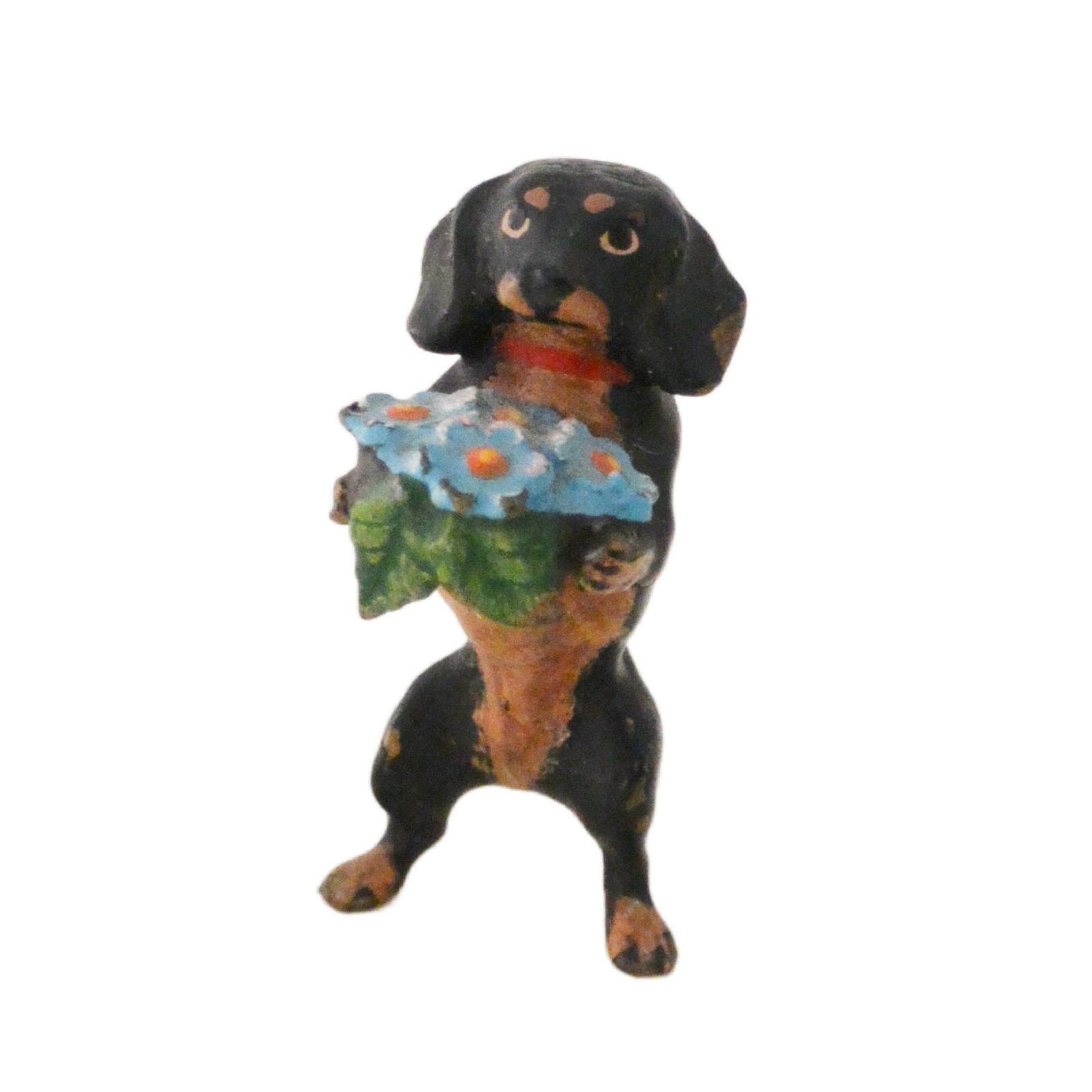 Dachshund with Bouquet — $128 — View in Our Shop | 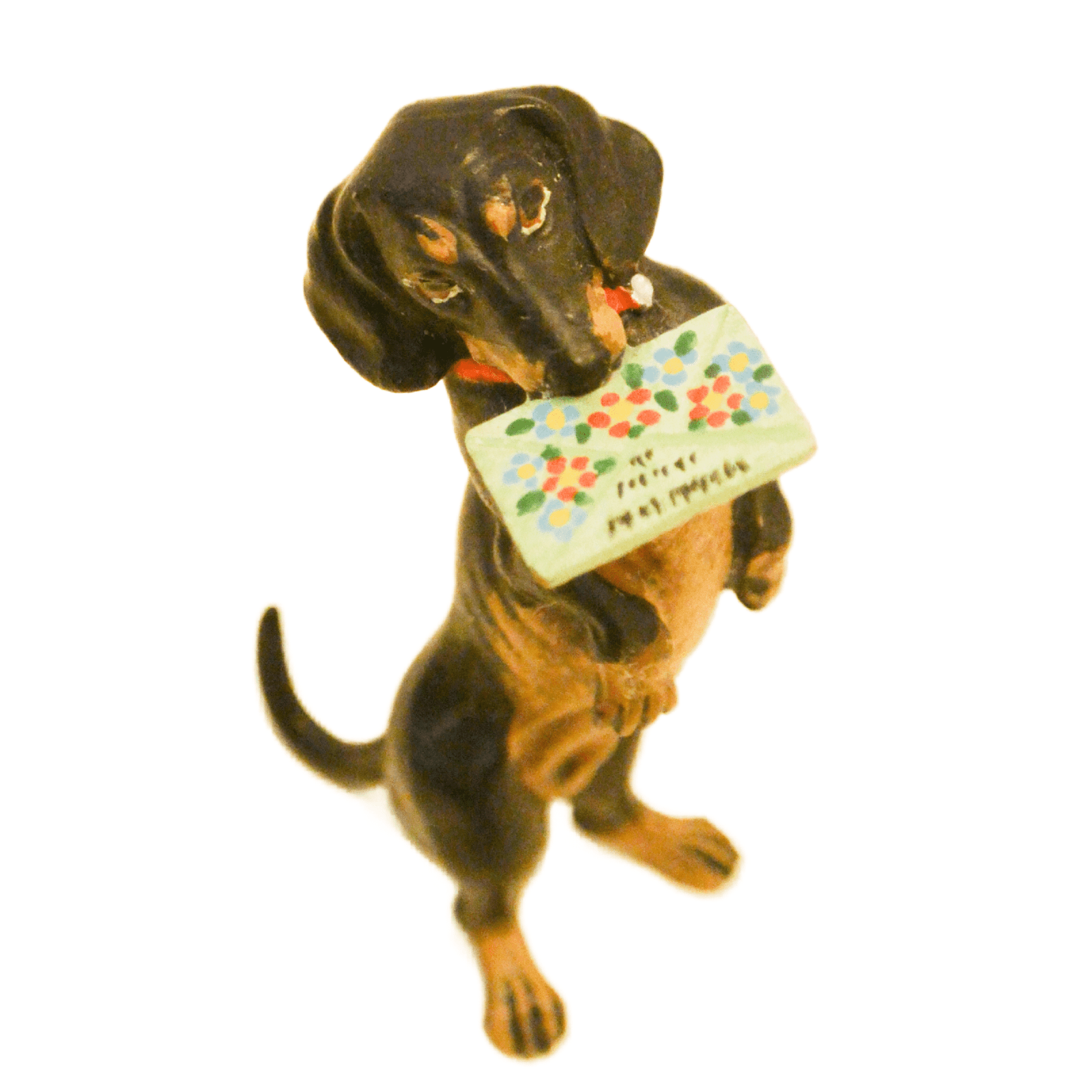 Dachshund with Greeting Card — $128 — View in Our Shop |
The Dachshund was a favourite Bergman subject precisely because of the breed’s comedic potential. A Dachshund solemnly offering a bouquet, clutching a greeting card, or standing at the altar with its bride — these scenes capture something genuinely true about the breed’s earnest, slightly self-important personality. Collectors respond to that warmth immediately, and it’s why even the tiniest Bergman Dachshund commands serious collector attention.
Bergman Napkin Rings — Functional Art at Its Finest
Among the most sought-after Vienna bronze pieces are the figural napkin rings — heavy bronze rings supported by one or more dachshunds in carefully modelled poses. These were made for actual use on Victorian and Edwardian dining tables, which makes surviving examples in fine condition particularly special. The weight of the bronze ring gives them a satisfying heft, and the detail on the supporting dachshunds is superb.
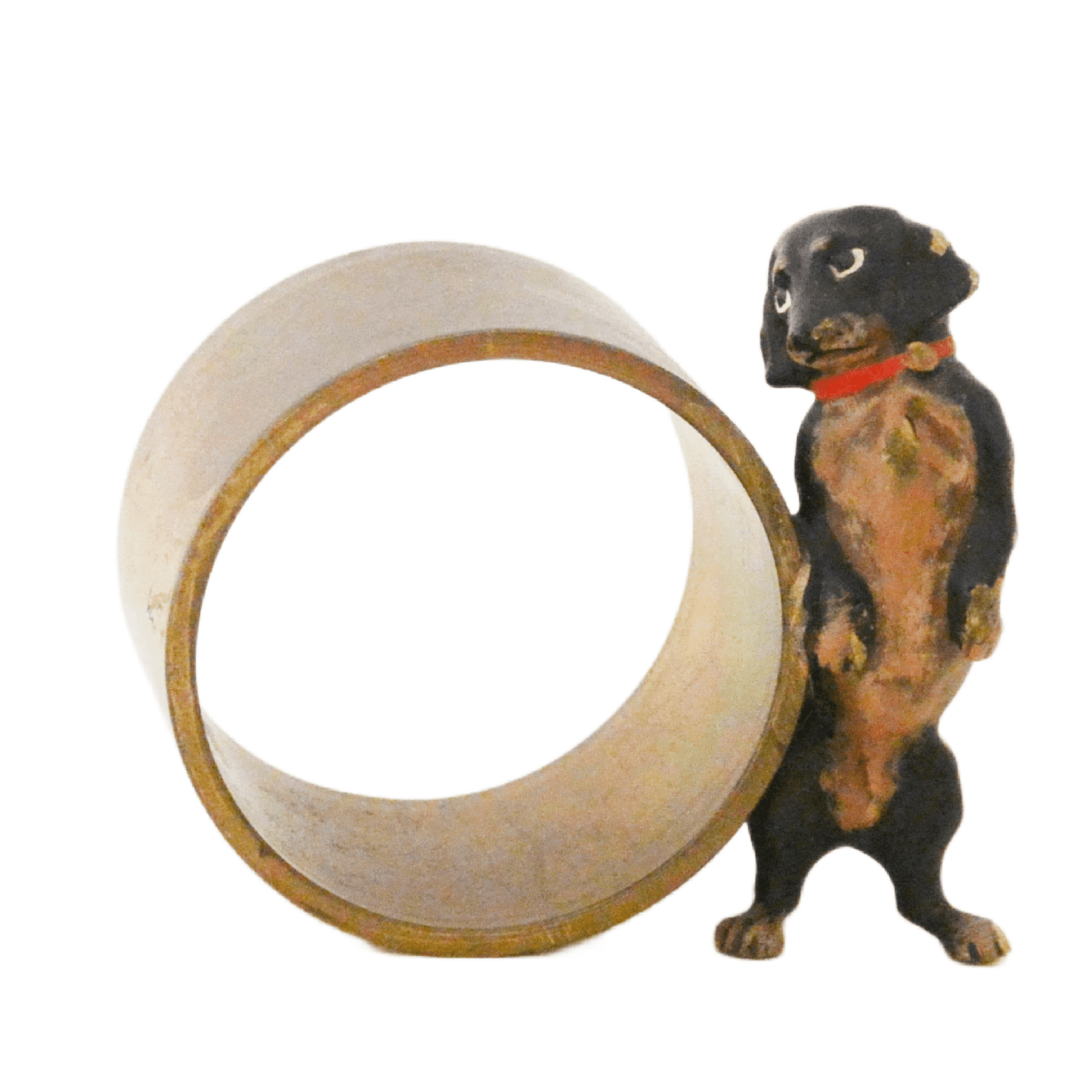 Dachshund Napkin Ring — $148 — View in Shop |  Franz Bergman Napkin Ring — $198 — View in Shop | 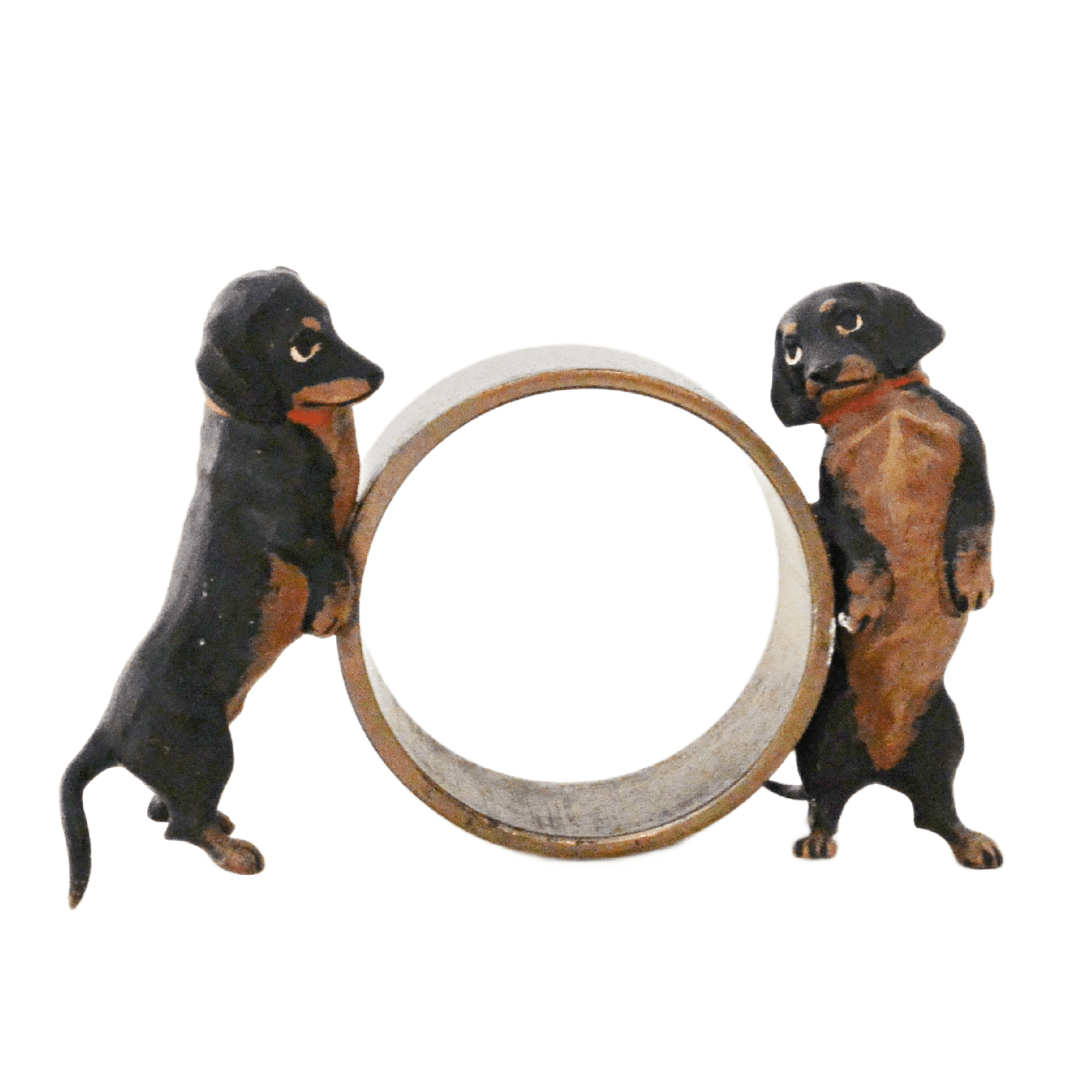 Two-Dachshund Napkin Ring — $398 — View in Shop |
Identifying and Caring for Vienna Bronzes
Authentic Bergman pieces are typically signed with one of two marks: a stylised letter “B” within an urn-shaped cartouche, or “Nam Greb” — “Bergman” spelled in reverse, used particularly on more risqué works. You may also see the word “Geschützt” (meaning “registered” or “protected”). Miniatures are often unmarked because of their small size, but can be attributed through quality of casting and the characteristic precision of the painted details.
Condition is everything with Vienna bronzes. Because the paint is cold-applied — never fired — it can be damaged by harsh handling, water, or cleaning chemicals. Minor paint loss is expected and acceptable in a piece over a century old; significant flaking will reduce value substantially. Never clean a Vienna bronze with water or solvents — a dry soft cloth and the gentlest touch is all that should ever be used.
Royal Bayreuth — Germany’s Master of Figural Porcelain
From the same country that gave the world the Dachshund comes one of the most delightful dachshund collectibles in antique porcelain: the Royal Bayreuth figural creamer. Royal Bayreuth was established in 1794 in Tettau, Bavaria — one of the oldest porcelain manufacturers in Germany — and between 1875 and 1920 they produced a remarkable series of figural wares in the shapes of fruits, vegetables, and animals.
What Makes Royal Bayreuth Figurals Special
The genius of the Royal Bayreuth figural creamers is that they are simultaneously functional objects and sculptural art. A creamer in the shape of a Dachshund isn’t a novelty item — it’s a beautifully crafted piece of hard-paste porcelain, hand-painted in the characteristic naturalistic colours of the breed, from which you could pour cream at breakfast. The combination of form, function, and fine craftsmanship is what makes these pieces so enduringly appealing to collectors.
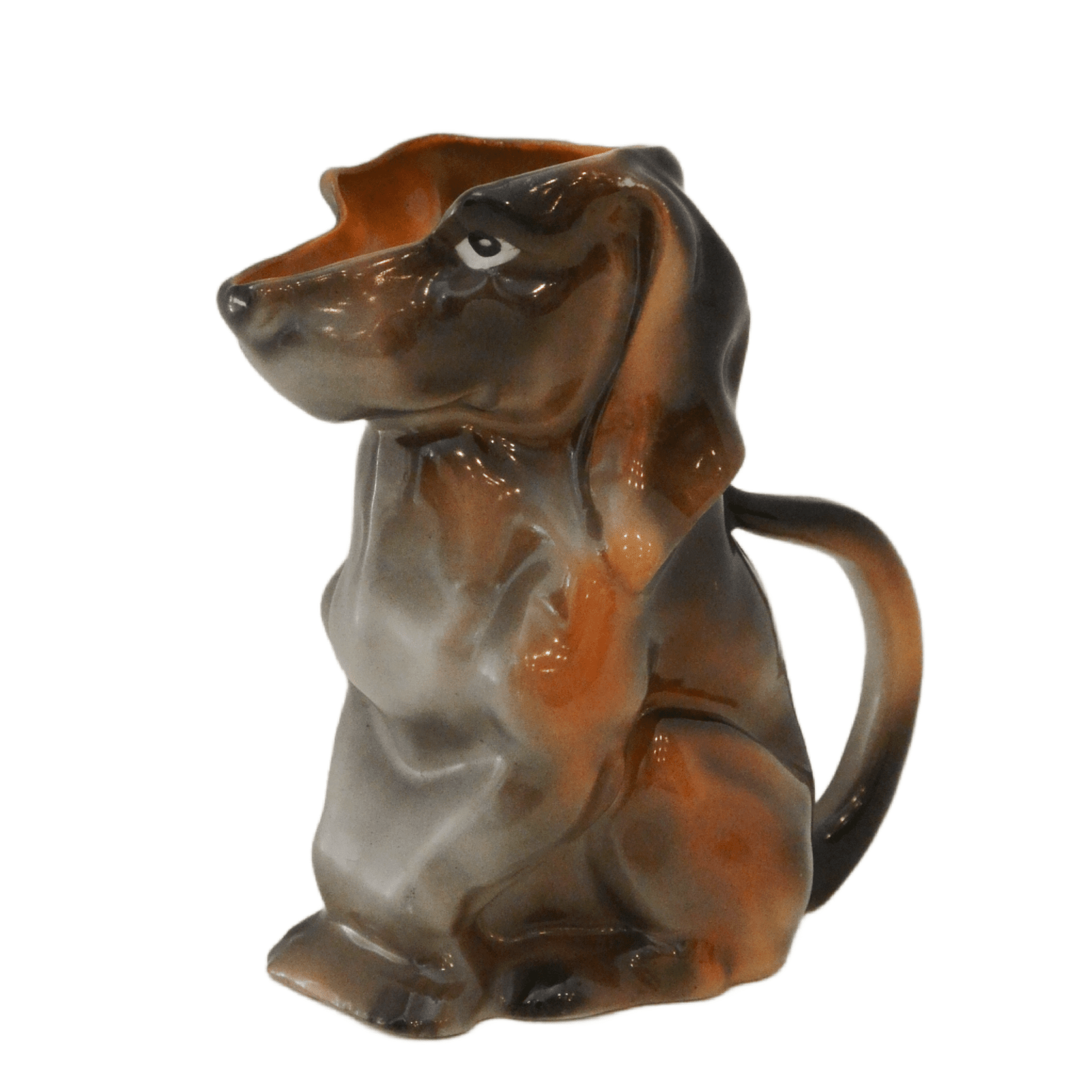 |
Royal Bayreuth Dachshund Figural Creamer, Tettau Bavaria — $158 — View in Our Shop |
Dating and Identifying Royal Bayreuth
The key to dating Royal Bayreuth pieces is the maker’s mark on the base. The factory used several different marks over the decades, and collectors and reference books have catalogued them carefully. The most desirable figural pieces — including the dachshund creamer — were made before 1917. Look for the “Royal Bayreuth” name in a shield or cartouche, often accompanied by “Bavaria” and a registration or pattern number. Early marks tend to be printed in blue or green underglaze.
Our Royal Bayreuth Dachshund Figural Creamer (pre-1940) is in excellent condition — a wonderful centrepiece for a Royal Bayreuth collection or for anyone who appreciates the intersection of fine craftsmanship and breed-specific charm.
Royal Doulton — Britain’s Champion Dachshund
Royal Doulton’s animal figurines are among the most beloved ceramic dachshund collectibles in the English-speaking world, and their HN1128 is one of the most iconic. The HN1128 — modelled by Frederick Daws and known formally as “Ch. Shrewd Saint” — was produced from 1937 to 1985, a production run of nearly five decades that speaks to its enduring popularity.
Frederick Daws and the HN Series
Frederick Daws was one of Royal Doulton’s most important animal sculptors, responsible for a series of dog figurines that captured champion show dogs of the era with remarkable fidelity. Each figure in the series was modelled after an actual champion — the “Ch.” prefix in the name is the traditional show ring designation for “Champion.” Daws had a gift for conveying both the physical character of a breed and its temperament. The HN1128 Black & Tan Dachshund communicates the breed’s characteristic expression with wonderful precision — clever, alert, and perhaps just slightly stubborn.
 |
Royal Doulton Black & Tan Dachshund HN1128 — $198 — View in Our Shop |
Identifying Royal Doulton Dog Figurines
Royal Doulton marks are well-documented and relatively straightforward to read. Look on the base for the “Royal Doulton” mark — usually a crown above a circular mark with the Royal Doulton name — along with the HN number and “Made in England.” The style of the mark helps date the piece: marks from the 1930s–1960s are slightly different from those used in the 1970s and 1980s. The sculptor’s name or initials may also appear. Condition issues to watch for include chips to the ears, tail, and legs, which are the most vulnerable points on any standing animal figurine.
|
Royal Copenhagen — Scandinavia’s Beloved Dachshund Puppy
Royal Copenhagen has been producing porcelain in Denmark since 1775, and their animal figurines rank among the finest in the world. The Royal Copenhagen approach to animal sculpture is different from both the German and British traditions — quieter, more naturalistic, with a soft luminosity in the glazes that gives their pieces an almost watercolour quality. Where a Rosenthal dog flows with Art Deco drama, a Royal Copenhagen dog simply sits, or plays, or sleeps — and somehow that simplicity is deeply moving.
Model 1408 — The Playful Dachshund Puppy
The Royal Copenhagen Dachshund Puppy (model no. 1408) was designed by sculptor Olaf Mathiesen, one of the factory’s most gifted animal artists. The design captures a puppy caught in the middle of attempting to roll over — its round little belly has got in the way, as round puppy bellies tend to do. It’s a moment of pure, unselfconscious joy, rendered in the muted browns and glossy glaze that are distinctly Royal Copenhagen.
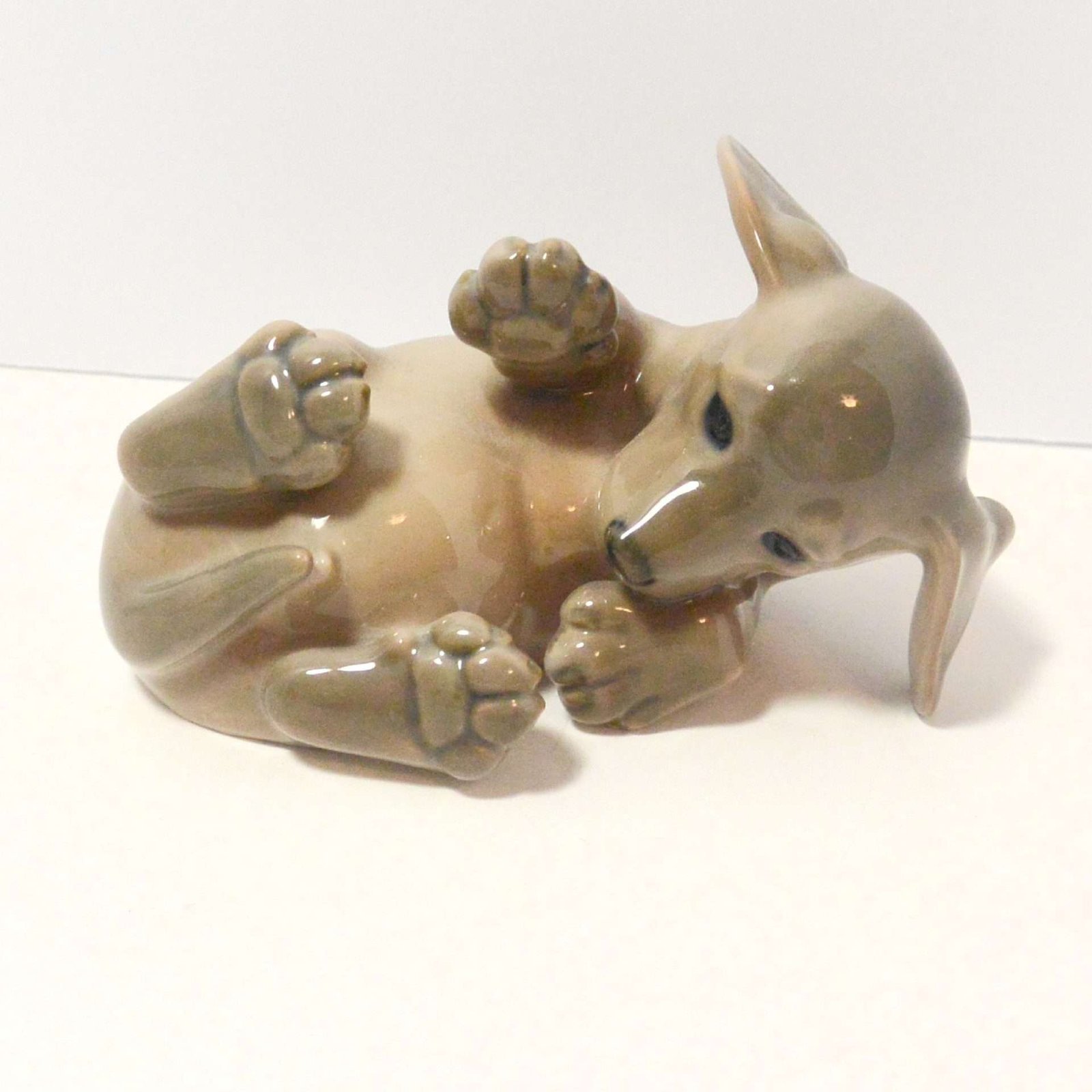 |
Royal Copenhagen Porcelain Dachshund Puppy, Model 1408 — $120 — View in Our Shop |
The Royal Copenhagen Mark
Royal Copenhagen marks are among the easiest to identify in the world of antique porcelain: look on the base for the famous three wavy blue lines representing Denmark’s three waterways, the Øresund, the Great Belt, and the Little Belt. These waves appear underglaze in cobalt blue, along with the “Royal Copenhagen” name and the model number (painted in green). The decorator’s initials are also typically hand-painted on the base — a reminder that every Royal Copenhagen piece was finished by hand.
Vintage German Porcelain — One-of-a-Kind Dachshund Art
Not every exceptional piece carries a famous name. Some of the most charming dachshund collectibles are the unmarked or lightly-marked pieces produced by smaller German porcelain workshops that never achieved international fame but whose craftsmanship was every bit as skilled. These pieces have a warmth and individuality that mass-produced items can never quite replicate — because each was essentially unique.
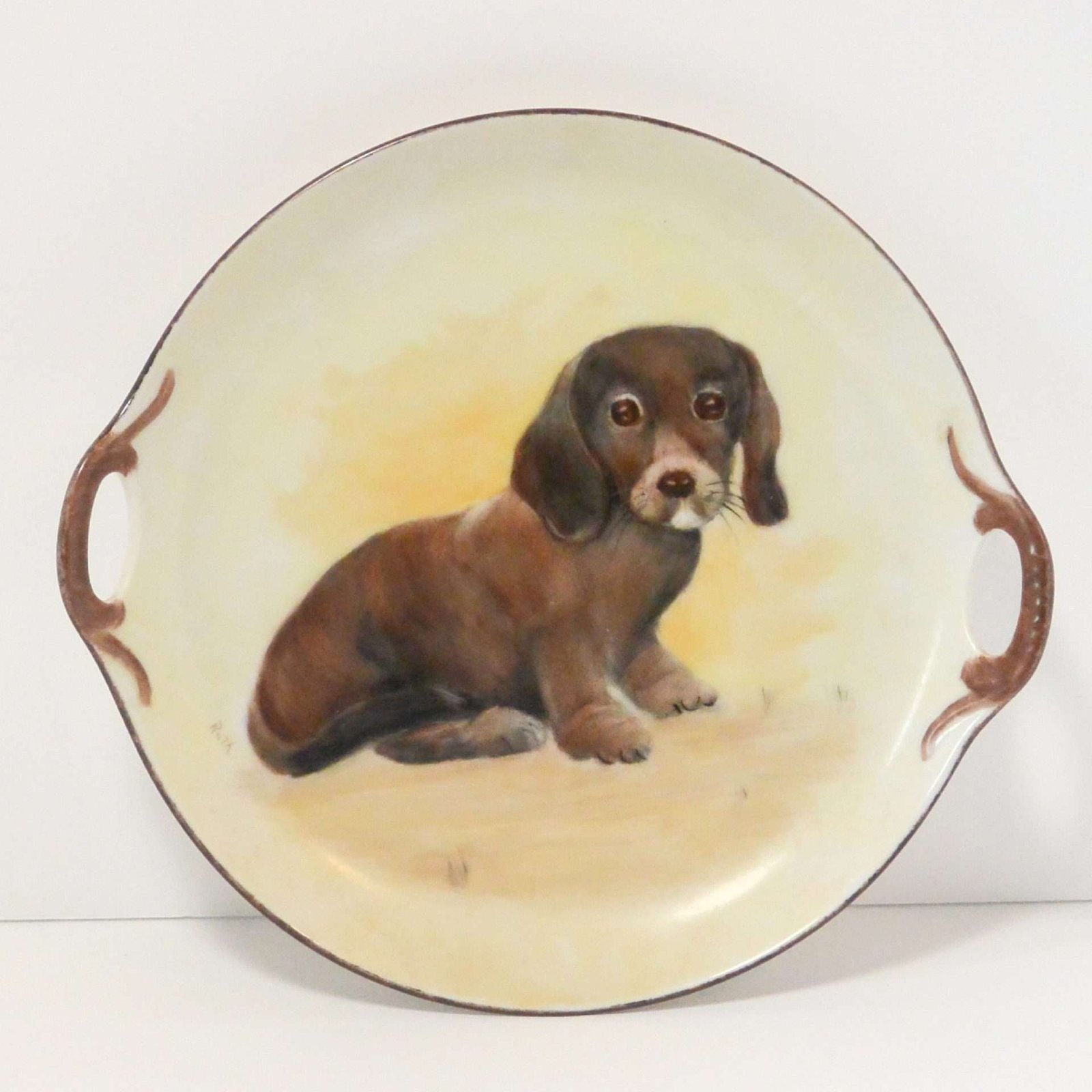 |
Vintage Hand-Painted German Porcelain Dachshund Dish — $86 — View in Our Shop |
Our vintage hand-painted porcelain Dachshund dish — believed to be German-made — is a perfect example. The puppy’s expression is something to behold: that particular Dachshund look that mixes soulfulness with barely-contained anticipation. At 7 inches across, it works beautifully as a trinket dish, a candy dish, or simply as a standalone piece of canine art. There is only one of these — when it’s gone, it’s gone.
Dachshund Jewelry — Collectibles You Can Wear
The world of antique and vintage dog jewelry is one of the most accessible and wearable corners of dachshund collectibles. A beautifully made silver pin or an enamel brooch can be both a serious collectible and an everyday pleasure — something you wear to a dog show, to an antique fair, or simply because it makes you smile every time you put it on.
Silver Dachshund Pins — Miniature Sculpture
The finest antique dog pins were made as miniature sculptures in sterling silver, with the same attention to anatomical accuracy and breed character that the best ceramic sculptors brought to their work. Our collection includes pieces from Kenart in England (a respected maker of silver animal jewelry from the 1950s–1980s), as well as unmarked sterling silver pieces whose quality speaks for itself.
 Sterling Silver Enamel & Ruby Brooch — $96 — View in Shop | 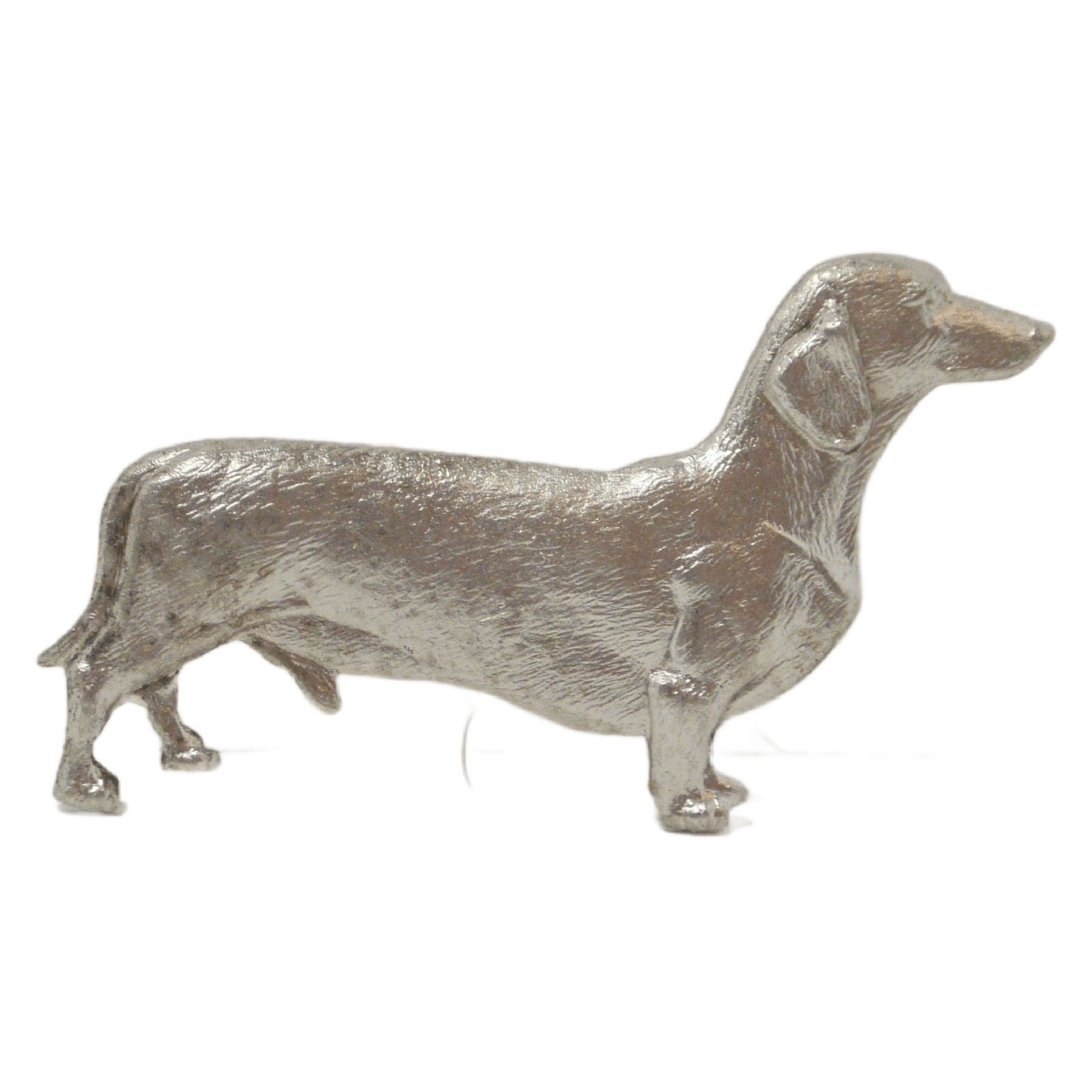 Vintage Silver Smooth-Haired Pin — $78 — View in Shop |
The sterling silver enamel and ruby brooch in our current collection is a particularly special piece — a brown enamel Dachshund body with a collar set with small natural rubies. At two inches long, it’s the perfect size for a lapel or a collar, and it arrives in excellent ready-to-wear condition. We also have a beautifully detailed sterling silver Dachshund pin at just $48 — a wonderful entry point for anyone beginning a vintage dog jewelry collection.
How to Identify and Date Your Pieces
One of the great pleasures of collecting dachshund collectibles is learning to read the marks — those tiny stamps, incised letters, and painted signatures that connect a piece to its maker, its country, and its era. Here is a quick reference for the key makers covered in this guide.
Vienna Bronzes (Bergman)
Look for a stylised “B” in an urn-shaped cartouche, or “Nam Greb” (Bergman backwards). The word “Geschützt” indicates a registered design. Miniatures may be unmarked — assess by quality of casting and painting detail. Never clean with water or solvents; use only a dry soft cloth.
Royal Bayreuth
Look for “Royal Bayreuth” in a shield or cartouche with “Bavaria” beneath, usually in blue or green underglaze. Pre-1917 pieces are the most collected. The figural creamers and novelty wares typically predate 1920. Reference books and the Royal Bayreuth Collectors Club are excellent resources for dating marks precisely.
Royal Doulton
The Royal Doulton mark features a crown above a circular cartouche with “Royal Doulton” and “Made in England.” The HN number identifies the model. For dog figurines, the sculptor’s name may appear — Frederick Daws pieces are particularly sought after. Check ears, tails, and legs carefully for chips or repairs.
Royal Copenhagen
The three wavy blue underglaze lines are unmistakable — they represent Denmark’s three waterways. Look for “Royal Copenhagen” in text and the model number in green. Decorator’s initials appear hand-painted on the base. The model number (such as 1408 for the Dachshund puppy) helps identify and date production runs precisely.
Start or Grow Your Dachshund Collection
The Dachshund collectibles market is wonderfully accessible to collectors at every level. You can begin with a $48 sterling silver pin and work your way toward a Franz Bergman bronze or a fine piece of Royal Bayreuth — or collect across all categories at once, building a dachshund collectibles display that celebrates the full range of how this extraordinary breed has been captured in art and craft over the centuries.
Our team selects every dachshund collectible in our collection with care, looking for examples that combine exceptional condition with authentic character. Whether a piece is $48 or $398, it arrives perfectly protected and beautifully wrapped just for you, with complimentary shipping within the USA.
|
About the Author Donna O’Connor is co-owner of A Dog’s Tale Collectibles, where our team hand-selects antique and vintage dog collectibles for collectors and dog lovers across the United States. We specialise in European bronzes, prestige porcelain, fine jewelry, and one-of-a-kind pieces that celebrate the dogs we love. |